
Do Nootropics Help with Verbal Fluency? Will They Make You A Better Public Speaker?

Can a supplement actually help you find the right words faster, or speak more fluidly under pressure? It's a fair question, and the honest answer is nuanced: some nootropic ingredients have solid evidence behind them for the cognitive functions that underpin fluent speech (memory recall, attention, staying calm under stress), while the evidence for directly boosting "verbal fluency" as a measured skill is thinner than most supplement marketing suggests. This article walks through what verbal fluency actually is, what the research does and doesn't show, and which ingredients have the best support.
What Is Verbal Fluency?
In cognitive science, "verbal fluency" has a specific meaning: it's the ability to retrieve words efficiently, usually measured by tasks that ask you to name as many words as possible in a category or beginning with a given letter within a time limit. It draws on several underlying systems at once — vocabulary stored in long-term memory, the executive function that searches and retrieves it, working memory to track what you've already said, and processing speed to do it quickly.
That matters for supplements because it means anything that genuinely helps verbal fluency probably does so indirectly — by supporting memory retrieval, attention, or by reducing the stress and anxiety that interfere with word-finding — rather than by acting on a dedicated "speech" mechanism. Keep that in mind as we go through the ingredients, because it's the key to separating realistic claims from hype.
What Does the Research Actually Show?
Here's where it pays to look closely at the evidence rather than the marketing.
L-Theanine: the best direct evidence
Of the commonly available nootropic ingredients, L-theanine (the amino acid found in green tea) has some of the most directly relevant evidence. In a randomised, placebo-controlled trial published in Nutrients in 2019, four weeks of L-theanine supplementation significantly improved verbal fluency—specifically letter fluency—as well as executive function, alongside reductions in stress-related symptoms. That's a rare case of a study measuring verbal fluency directly and finding a benefit, and it fits the mechanism described above: L-theanine promotes a calm, focused mental state, which is exactly the condition under which word-finding tends to flow more easily.
Bacopa monnieri: good for memory, weaker for speech specifically
Bacopa monnieri is often promoted for verbal ability, but the evidence deserves an honest framing. A systematic review of randomised controlled trials found that Bacopa reliably improves one thing in particular: memory free recall. The same review noted a genuine gap—there was very little research on language and verbal-behaviour domains, so claims that Bacopa specifically boosts verbal fluency outrun the current evidence. Bacopa may well help the memory-retrieval component that supports fluent speech, but it shouldn't be sold as a proven fluency enhancer.
Caffeine and the caffeine–L-theanine pairing
Caffeine on its own sharpens alertness and reaction time, and a systematic review of the caffeine–L-theanine combination found consistent benefits for attention and overall cognitive performance. Better sustained attention doesn't equal better vocabulary, but it does support the real-time concentration that keeps you on-topic and articulate during a long conversation or presentation.
The stress-and-anxiety angle
One of the most underrated obstacles to fluent speaking isn't cognitive at all—it's anxiety. Word-finding notoriously falls apart under acute stress. Ingredients that genuinely reduce anxiety (L-theanine again has the strongest evidence here) can help less by making your vocabulary bigger and more by keeping the stress response from getting in the way of the vocabulary you already have.
What This Means Practically
- Be sceptical of any supplement marketed as a direct "verbal fluency" or "public speaking" pill—the evidence for direct effects is limited, and most benefit is indirect.
- L-theanine has the best-supported case, with a controlled trial showing improved letter fluency and reduced stress.
- Ingredients that support memory recall (like Bacopa) and sustained attention (like the caffeine–L-theanine pairing) may help the underlying systems, even if they don't act on "speech" as such.
- Managing anxiety may do more for your fluency in a high-pressure moment than any cognitive boost—which is worth remembering before your next presentation.
- Preparation and practice still matter more than any supplement. Think of these as marginal support, not a substitute for knowing your material.
Where a Formulated Nootropic Fits
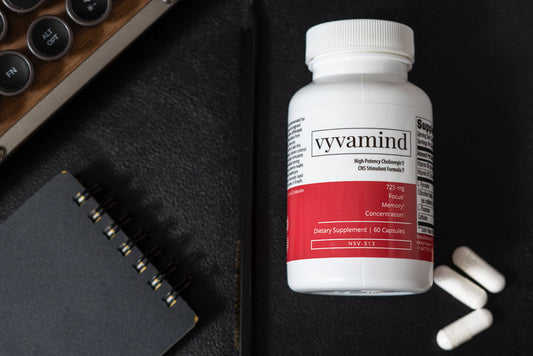
If you'd rather not assemble these ingredients individually, a pre-formulated nootropic can be a convenient way to get several of them at sensible doses. Vyvamind, for instance, combines L-theanine and caffeine (the pairing with the best attention evidence) with citicoline, L-tyrosine and B-vitamins. It won't turn anyone into a natural orator—no supplement will—but the calm-focus and attention support it provides target the realistic, indirect mechanisms discussed above rather than a marketing promise about speech itself. As always, check with a healthcare provider before starting any new supplement, particularly if you take medication or have a health condition.
This article is general information, not medical advice.
Sources:
- Hidese S, Ogawa S, Ota M, et al. Effects of L-Theanine Administration on Stress-Related Symptoms and Cognitive Functions in Healthy Adults: A Randomized Controlled Trial. Nutrients. 2019;11(10):2362. https://pmc.ncbi.nlm.nih.gov/articles/PMC6836118/
- Pase MP, Kean J, Sarris J, et al. The cognitive-enhancing effects of Bacopa monnieri: a systematic review of randomized, controlled human clinical trials. J Altern Complement Med. 2012;18(7):647-652. https://pubmed.ncbi.nlm.nih.gov/22747190/
- Sohail AA, Ortiz F, Varghese T, et al. The Cognitive-Enhancing Outcomes of Caffeine and L-theanine: A Systematic Review. Cureus. 2021;13(12):e20828. https://pmc.ncbi.nlm.nih.gov/articles/PMC8794723/